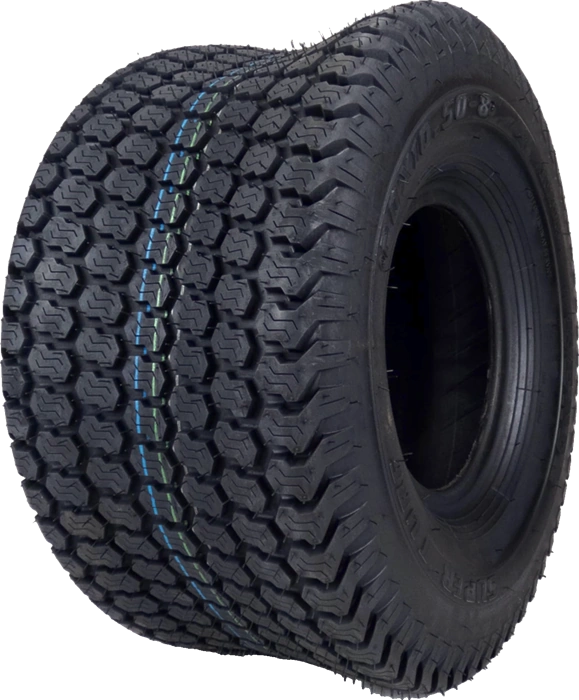

The short answer: ply rating is a strength rating, not a layer count. A modern 4-ply tire doesn’t have four layers of anything — it has a carcass built to the strength the old four-cotton-ply tires had. Higher rating means a tougher, stiffer tire that carries more load and shrugs off more abuse. For most mowing, 2-ply is honestly fine; 4-ply is the working-machine standard; 6-ply is for real weight and real hazards.
What “ply” actually means today
Decades ago, tires were built up from actual layers — plies — of cotton cord, and more layers meant more strength. Materials got better; the layers got fewer. Today’s “4-ply” small tire might be built from two plies of modern polyester that outmuscle the four cotton plies of 1955. So the industry kept the number as a rating: this tire is as strong as a four-ply used to be. That’s all it promises. It’s a strength grade wearing a history costume.
Two practical things follow. First, you can’t judge a tire by peeling back the rubber and counting — the number on the sidewall is the spec. Second, more ply rating buys you a stiffer carcass and thicker protection, which is sometimes exactly what you need and sometimes just money and harshness you didn’t need to buy.
Load range letters, mapped
Newer sidewalls often skip “ply” and stamp a load range letter instead. Same idea, different alphabet:
A
- Ply rating equivalent
- 2-ply
- Where you meet it
- Light mowing duty — flat lawns, no attachments
B
- Ply rating equivalent
- 4-ply
- Where you meet it
- The small-equipment workhorse — garden tractors, carts, ZTRs
C
- Ply rating equivalent
- 6-ply
- Where you meet it
- Loaded tires, slopes, trailers, rough ground
D
- Ply rating equivalent
- 8-ply
- Where you meet it
- Heavy trailer and compact-equipment territory
If your old tire says “Load Range B” and the replacement says “4 Ply Rated,” those are the same answer in two languages. Don’t pay extra to translate.
2 vs. 4 vs. 6 on small equipment
2-ply is the honest choice for a mower that mows — a flat suburban lawn, no cart, no blade. It’s cheaper, it rides softer, and its lighter carcass actually treads gentler on grass. Front tires on riding mowers are 2-ply from the factory for a reason.
4-ply is where garden tractors and working rears live. If the machine pulls a cart, carries a bagger full of wet clippings, or works ground that isn’t a lawn, the stiffer carcass resists punctures and squirm. When we recommend ply on our fitment pages, 4-ply rears show up over and over — that’s not upselling, it’s just the correct default for a machine that does anything besides mow.
6-ply is for genuine load and hazard: fluid-filled tires, wheel weights, pallet forks on a subcompact, steep slopes that side-load the sidewalls, brush and stubble that eat lighter tires. If you’ve ever had a sidewall failure — not a tread puncture, a sidewall — that’s the signature of a tire working above its rating.
When more ply is the answer — and when it’s wasted money
Buy up in ply when the failure mode is strength: repeated punctures, sidewall cuts, tires squatting under loaded weight, a machine that slings pallet forks or pushes snow with ballast in the tires. Slopes deserve a special mention — a hillside constantly flexes the downhill sidewall, and a stiffer carcass takes that abuse far better.
Don’t buy up when the failure mode is traction. A spinning turf tire on a wet hill doesn’t need two more plies — it needs a different tread, which is a different article: turf vs. lug tires. And don’t buy up “just to be safe” on a light mower — you’ll pay more for a stiffer ride and a harder tire that marks the lawn more, protecting against loads the machine can’t even generate. Our counter rule: “Match the ply to the heaviest thing the machine actually does, not the heaviest thing it could theoretically do.”
Reading it off the sidewall
Look for either “4 PLY RATED” (sometimes “4PR”) or “LOAD RANGE B” molded near the size. Match or exceed what came off the machine — dropping a working rear from 4-ply to 2-ply to save a few dollars is the one direction that reliably disappoints. If you’re comparing two specific turf tires and ply is the tiebreaker, our K500 vs. Turf Master comparison works a real example — Kenda is a name you’ll see all over that page — and every tire on the mower tires page lists its ply rating up front.
Common questions
Tires in this guide
Sold and shipped by Greater Cleveland Tire — from our Cleveland warehouse in one business day.
The shelf example