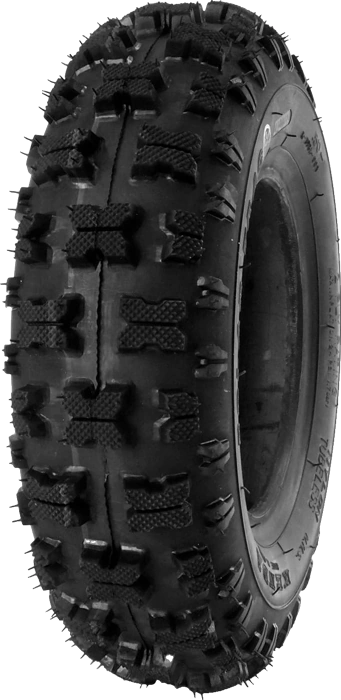

The short answer: for most garden tractors on plow or blower duty, chains over the turf tires you already own are the best value in snow work — they grip hard, they cost the least, and the trade-off is some marking on the lawn and driveway. A dedicated winter tire like the Kenda K398 Polar Trac is the cleaner, quieter answer if you swap wheels seasonally. But before either one: ballast. Weight on the drive wheels moves more snow than any tread ever will.
Every November this conversation starts at the counter, and every November I give the same slightly unglamorous answer. Let me walk you through it the way I do in person, cheapest fix first.
What actually matters: weight on the drive wheels
A snow blade doesn’t stall a garden tractor because the tires are bad — it stalls it because a light rear end spins. Traction is grip times weight, and a garden tractor built to tiptoe across a lawn is light in the tail by design. Wheel weights, a ballast box, or loaded rear tires transform snow performance more than any tread swap, and I’ve watched people spend real money on aggressive rubber to fix what fifty pounds a side would have. Whatever you decide about chains and tires below, decide about ballast first. It’s the difference between a tractor that pushes snow and one that polishes it.
Chains on your turf tires: the honest case for them
Two-link ladder chains over a stock turf tire grip packed snow and ice better than almost any bare tread — the steel bites where rubber skates. They go on in twenty minutes once a year, come off in ten, and cost a fraction of a pair of tires. For a machine that plows a driveway a dozen times a winter and mows the rest of the year, chains are usually where I point people, full stop.
Now the honest part. Chains mark. On frozen lawn they’ll leave prints you can see in spring if you turn hard; on a concrete or paver driveway they scuff, and on a surface you’re proud of, that matters. They’re also a rougher ride on cleared pavement and they announce your seven a.m. plowing to the whole street. None of that is a defect — that’s just what steel on the ground is. If your driveway is gravel or plain asphalt and your lawn goes dormant under snow anyway, you may never notice a downside.
The dedicated winter tire: the K398 Polar Trac
The step up is a true winter tire. The one we stock is Kenda’s K398 Polar Trac — a winter-service tread made for exactly this duty: deeper, more open lugging than a summer turf tire so it bites snow, without going full ag chevron. Paired with wheel weights, it turns a garden tractor into a genuinely capable snow machine that’s quiet on pavement, doesn’t scuff the driveway, and doesn’t need wrestling on and off every season.
The catch is workflow, not performance: a winter tire earns its keep when it lives on a second set of rims you swap on at Thanksgiving and off at Easter. Running it year-round wastes it — winter compounds and open treads wear faster on warm pavement and mow uglier than turf. If you’re not up for a seasonal wheel swap, be honest with yourself and buy chains.
The lug-and-weight combo
Third path: an AG/R1 lug rear plus ballast, no chains. This is the right answer for the machine that works all year — garden in the spring, cart all summer, blade all winter — because the lug earns its keep in every season, not just January. On snow it’s good-not-great: lugs bite fresh and deep snow well but polish out on hard-packed ice where chains keep biting. And lugs mark soft lawns all year, which is the trade the turf-vs-lug guide walks through. Buy lugs for the year-round work and treat the snow performance as included; don’t buy them as a snow-only play.
The verdict, by situation
Plow a dozen times a winter, mow all summer
- Buy this
- Chains + ballast
- Why
- Best grip per dollar. Marking is the only real cost.
Serious snow duty, second set of rims
- Buy this
- K398 Polar Trac + weights
- Why
- Chain-free grip, clean on pavement, swap seasonally.
Machine works year-round (garden, cart, blade)
- Buy this
- Lug rears + ballast
- Why
- One tire for every season; add chains only if ice wins.
Flat, short driveway, light snow
- Buy this
- Ballast alone, maybe nothing
- Why
- Honestly? Turf tires push light snow fine with weight behind them.
Notice chains show up twice and “nothing” once. For many driveways, chains plus the turf tires you already own is the whole answer, and I’d rather tell you that than sell you rubber you don’t need. Most garden tractors in this conversation run a common rear size like 16x6.50-8, so that’s a good place to start checking fit. When you do want the winter tire or the weights, the mower tires page is where our stock lives.
Common questions
Tires in this guide
Sold and shipped by Greater Cleveland Tire — from our Cleveland warehouse in one business day.
The dedicated snow tread