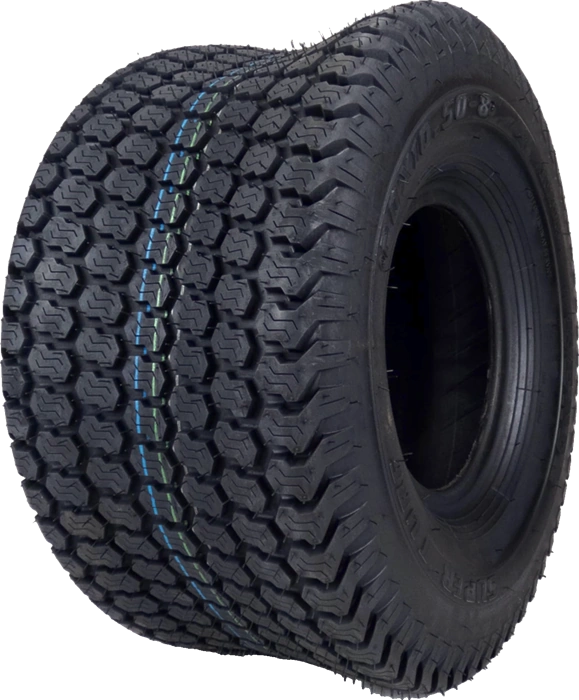

The short answer: zero-turns wear out rear tires fast because the thing that makes them great — spinning on their own axis — grinds the rear tread against the ground on every turn. You can’t change the physics, but you can roughly double tire life by changing how you turn: three-point turns at the end of each stripe instead of true zero-radius pivots, slower turn inputs, and honest pressure discipline.
I hear the same complaint every spring: “My tractor tires lasted ten years, this zero-turn needs rears already.” Nothing’s wrong with your machine. Here’s what’s actually happening and what’s worth doing about it.
Why the rears take the beating
On a garden tractor, the rear tires mostly roll. On a zero-turn, they steer — and in a true zero-radius pivot, the inside rear wheel stops or reverses while the machine rotates around it. That wheel isn’t rolling anymore; it’s scrubbing, twisting a few hundred pounds of mower against dry turf like a pencil eraser. Do that at the end of every stripe, both directions, an acre at a time, and you’re sanding the tread off in neat little installments. The fronts skate on casters and barely wear. The rears pay for everything.
Turf tread makes it worse in one specific way: those small, shallow blocks that are so gentle on grass also have edges everywhere, and scrubbing wears block edges first. That’s why a worn zero-turn rear looks rounded-off and smeared rather than evenly balded.
The habits that cut wear roughly in half
- Three-point turns at the stripe ends. Instead of pivoting on the inside wheel, keep both wheels rolling: swing wide, back up a touch, pull forward into the next stripe. Both tires keep rolling instead of grinding, and as a bonus you stop tearing divots in the turnaround strip at the ends of your lawn.
- Slow your hands down. Wear scales with how violently the wheel scrubs. The same turn made at half the lever speed costs a fraction of the rubber. You lose maybe two minutes an acre. Your neighbor with the stopwatch will never know.
- Vary the pattern. If you strike the same stripes every week, every turn happens on the same two strips of lawn — and the same arcs of tire. Rotating your mowing direction spreads the scrub around, on the grass and the rubber both.
- Stay off the pavement. Scrubbing on turf is abrasive; pivoting on concrete is a belt sander. Roll straight across the driveway, turn on the grass.
Pressure discipline, the boring multiplier
Underinflated rears wear faster everywhere, but on a zero-turn it compounds: a soft tire squirms during the pivot, so the whole tread face smears sideways instead of just the contact patch working. Soft tires also make the machine cut unevenly, which tempts you into more correction turns. Check pressure monthly with a real gauge — small tires lose air faster than car tires, and the difference between correct and “looks fine” is invisible from the seat. Your operator manual and the sidewall give you the numbers; the sidewall max is a ceiling, not a target. Uneven side-to-side pressure also makes the machine pull, and a machine that pulls gets steered constantly, which is — you guessed it — more scrub.
When to throw rubber at the problem
If your habits are already clean and you’re still eating rears, the fix is a heavier tire. A 6-ply turf tire in your same size — the Kenda K500 Super Turf is the one I reach for most — runs a stiffer carcass and typically a harder-wearing compound than the 4-ply that shipped on the machine — it gives up a little cushion and costs a bit more, and for high-hour or commercial-adjacent mowing it’s worth every penny. The K500 hill-yards comparison digs into when the 6-ply step-up makes sense. What a heavier tire won’t do is fix a pivot habit — a 6-ply scrubbed hard still wears, it just sends you a slower bill.
And to close the loop on a question I get weekly: no, switching to lug tires doesn’t solve zero-turn wear. Lugs on a zero-turn tear turf badly during pivots — the turf-vs-lug guide covers why tread choice is about traction, not longevity. For a lawn machine, stay turf and fix the ply and the habits.
Common questions
Tires in this guide
Sold and shipped by Greater Cleveland Tire — from our Cleveland warehouse in one business day.
The 6-ply rear answer